Keyholder coverage is the constraint everything else bends around
A cafe usually has two or three people who can open, and no slack behind them. That single fact shapes the whole week: the early shift is not a slot you fill last, it is the fixed point the rest of the rota is built around.
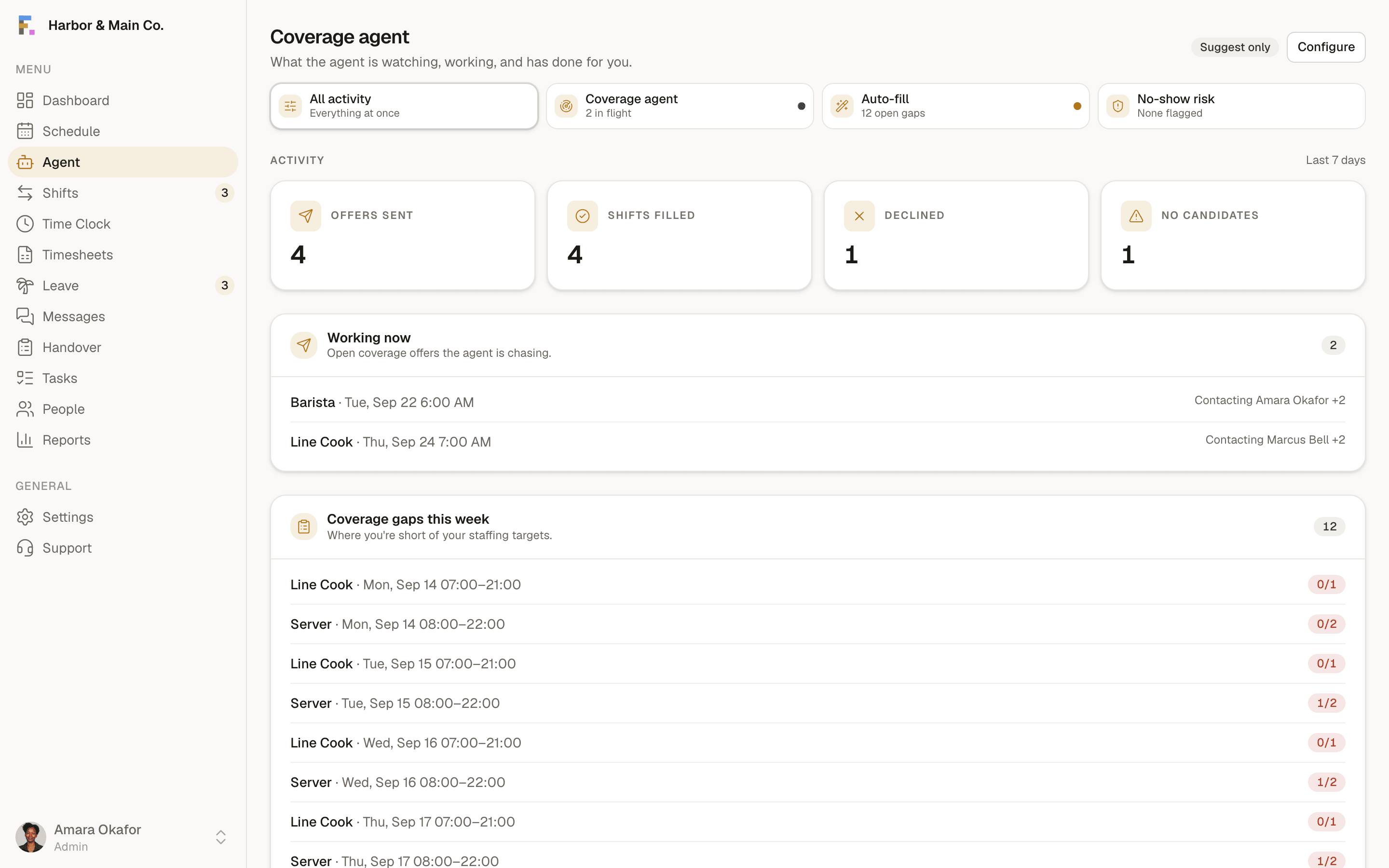
Treating keyholder as a position rather than as a name makes the constraint visible. An early slot reads as short until somebody who holds a key is on it, and it reads that way while you are still building rather than at five the next morning. It also survives staff turnover, because the requirement lives on the shift rather than in somebody's memory of who has a key.
The useful reframing is that keyholder is a position, not a person. Once it is one, an open is a shift that requires it, the rota can tell you before Monday that Thursday has nobody who holds it, and the question of how many keyholders you need becomes answerable rather than a thing you discover the morning one of them is ill.
Why a cafe rota lives or dies on the early shift
Everything downstream of a late open is worse than the late open. The queue that forms, the pastries that were not out, the regular who goes elsewhere. And the early shift is the one with the fewest eligible people, which makes it both the most fragile and the hardest to cover at short notice.
The practical answer is to know the gap early and to widen the pool deliberately. Certification and keyholder status sit on the person with an expiry date, so somebody about to lapse is flagged before they silently stop being eligible. If the pool for the early shift is two people, that is a staffing decision to make in advance, not a discovery to make on a Tuesday morning.
The early shift is also where rest gaps go wrong most quietly. A close finishing after eleven and an open starting at six leaves under the minimum in several regions and is uncomfortable everywhere, and it is almost never scheduled deliberately. It happens because the two shifts sit at opposite ends of the week's grid and nobody reads them as a pair.
Small teams, short shifts, and the ninety-minute rush
Cafe demand is spiky in a way that a daily headcount cannot express. The morning peak can need three people and the two hours after it can need one, and scheduling to the average produces both a queue and idle wages on the same day.
Setting cover by daypart lets a short shift exist for the reason it actually exists. A two-hour shift that covers a peak then reads as deliberate on the grid instead of looking like somebody was scheduled badly, which matters when the person working it wants to know why their shift is short. It is also the honest way to see whether the peak justifies the headcount at all.
There is a limit worth respecting here. A shift short enough to be purely useful to the business is often not worth the journey to the person working it, and some regions set a minimum length for exactly that reason. Covering a rush with an existing shift that starts earlier or ends later is usually better than adding a two-hour one that nobody wants.
One person off sick is a large fraction of a small team
A team of six has no bench. A single absence removes a meaningful share of the week's capacity, and if that person happens to hold the qualification or the key that the shift needs, the gap is not a staffing inconvenience, it is the shop not opening properly.
Small sites are where the ranking of who to ask actually matters, because the list of people who could take the shift is short and half of them are already working that day. Knowing who is qualified, who is available, who is already near their hours and who has covered the last three gaps turns a round of hopeful messages into one accurate ask. The alternative is a manager working the shift themselves, which is the version of cover that never appears in any cost report.
This is also the strongest argument for deliberate cross-training in a small site. Two people who can open and two who hold the certification is not redundancy for its own sake, it is the difference between an absence and a closure. The rota is where you find out whether you actually have that, because it is the only place the overlap between qualification and availability is visible.
Closing tasks, and the twenty minutes after the door is locked
The published shift ends when the shop closes. The work does not. Machines get cleaned, the till gets cashed up, the fridge gets restocked for the morning, and somebody is doing all of it after the last customer has left.
When that time is not in the rota it gets handled in one of two ways, both bad. It is worked and not paid, which is a liability quietly accruing, or it is clocked and unexpected, which turns up as an overtime line nobody planned. Putting the closing time in the shift makes it a scheduled cost rather than a surprise, and it makes the actual length of a closing shift visible when you are deciding who can reasonably open the next morning.
It also gives you something to check. When the scheduled shift and the clocked shift disagree by the same twenty minutes every night, that is a scheduling error worth fixing rather than a discipline issue, and it is only visible if the two are recorded separately and compared.